Why invest in an IBCLC? You may have noticed I’m just beginning my journey as an IBCLC.  The truth is Read more
The knitted boobs should help me to show you what I’m talking about and stop me from instinctively grabbing my Read more
January seems to be a time filled with words of change.  In relation to breastfeeding mothers wanting to know how Read more
My baby is screaming crying and it is making every cell in my body scream along too.  I want to Read more
Christmas, a time for being with family, relaxing by the fire, enjoying the odd glass of something nice, opening gifts, Read more
Me! Well, yes but there are many people with the IBCLC credential that work in different environments so their IBCLC Read more

Why invest in an IBCLC?

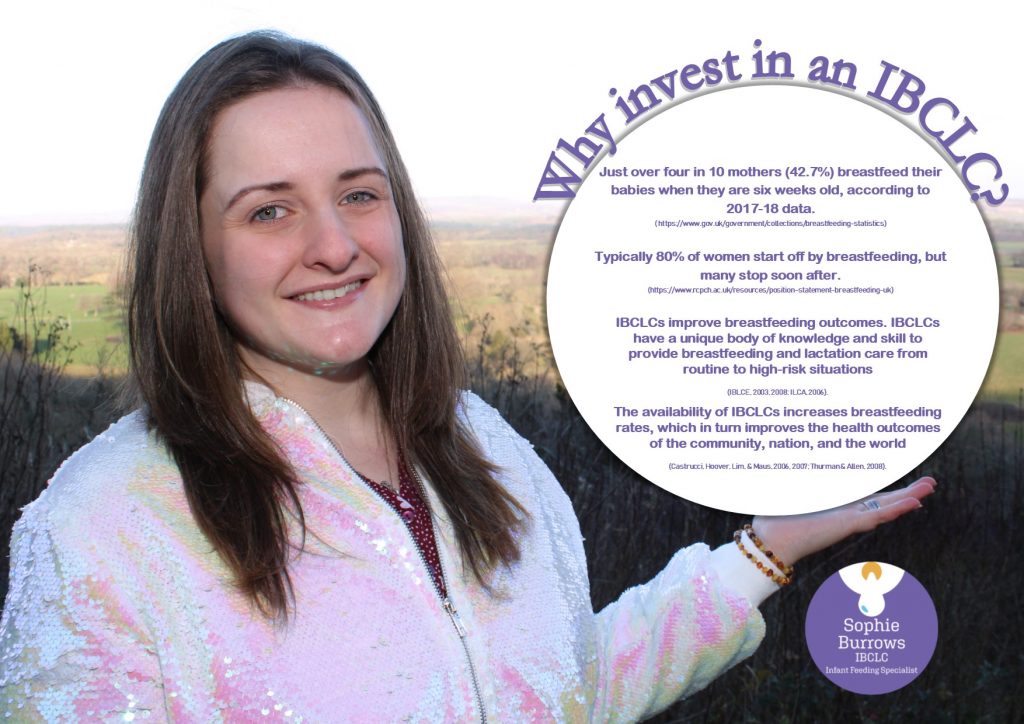
You may have noticed I’m just beginning my journey as an IBCLC.  The truth is I’ve been studying for this role for over a year with a time investment of well over 2 years.  This meme I hope makes sense of why IBCLCs are a good investment.

It’s hard for me to put a charge on this work especially because I have been working as a volunteer for so long.  It feels uncomfortable to charge a price but the skill I’ve gained was done through taking expensive exams and spending hours of my time learning and researching.  Its uncomfortable to charge a mother in her most vulnerable state to work on something we generally feel we should apparently naturally be able to do. I know however that breastfeeding is a skill often that needs nurturing to achieve and I also see how important it is to the person breastfeeding to breastfeed but unfortunately “the powers that be” don’t see it in quite the same way.  If I could get reimbursed for my time, equipment and effort by another means than the mother, things would be a little easier in terms of the feelings surrounding charging a mother but one thing I know is the skill I have is valuable.

It’s taken me 7 years of motherhood to realise that my time is valuable.  I’ve given hours of myself and my talents with no monetary value attached to them and realised that it is my life passion and with that knowledge and skill comes a true value and path of life.

IBCLCs make a difference to an infant feeding relationship, they will do their best to stand by you when you are struggling through and offer support and trusted information so you can reach your feeding goals.

I hope you understand why an IBCLC is a good investment.

See you in the next blog, The Boob Lady

RCPCH- Position Statment on Breastfeeding in the UK

Government Breastfeeding Statistics

Position Paper on the Role and Impact of the IBCLC

Breastfeeding rates decline – womans public health england

* Disclaimer, this probably won’t be the exclusive contense of my bag, it may also differ very much to the contense of another IBCLCs bag.
 

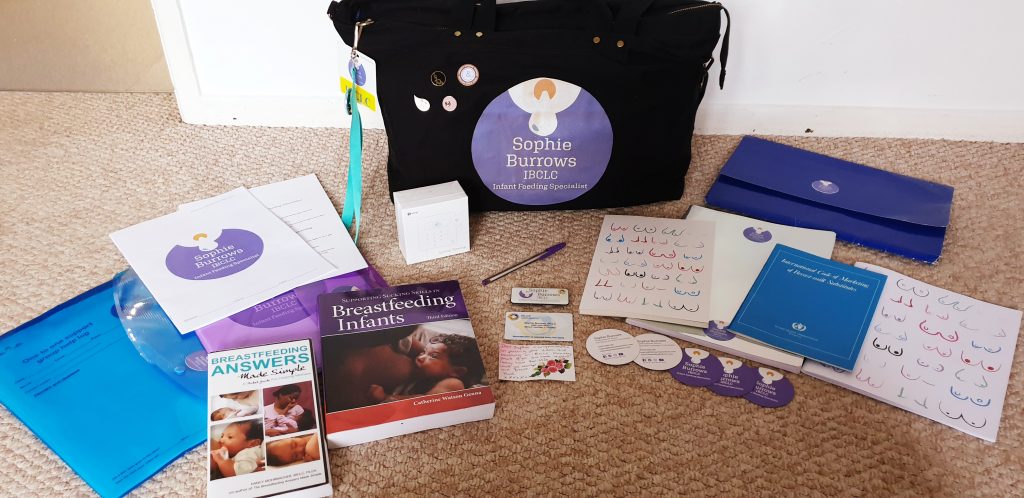
As an IBCLC I have a tool kit with me to hopefully make my job easier and provide you with the support you need now rather than having to send you on your way with a list of things to get having not get very far and probably feeling like you are climbing a mountain (I know I climbed Mt Kenya. NEVER again it was tough)

My bag contains:

Firstly, we have the knitted stuff.  This helps a lot for me to visually show you what I’m talking about or how to achieve something.  The knitted nappy there is the different types of baby poo you can expect from birth onwards and is helpful to show where you are at.  It takes a while as parents for us to elaborate about poo but by about 6 weeks you become pretty ace at describing everything until one day your child eats banana and there black streaks in the poo and you panic your child might have something seriously wrong or they’ve eaten a crayon with a great effect too and you go to panic stations until you’ve traced back every last step since the last bowel moment!  The knitted boobs should help me to show you what I’m talking about and stop me from instinctively grabbing my own breasts to indicate what I mean by breast compressions or in general talking about many different things.  I will probably still go for my own breast and then remark on how I kitted the breast to stop that happening but having been a breastfeeding mum myself it ends up feeling like normal!

Then, we have the tubes, syringes, manual pump, nipple shields, gloves, cups and tape.  I hope to not need to use these much at all but they are part of my kit for those situations where more milk might be needed or a tool will help things along to get a baby back to the breast or I might have to take an assessment of baby in their mouth with gloves on. This bit of my bag can seem a bit daunting but I’m confident with why each bit is in there and over time I might decide I don’t need all of these bits but even if I use them only to demonstrate the possibilities to give a mother hope then it was worth it. 

Heres the paperwork part of my bag!

Next, we have the paper side of the bag, this section of it includes a folder that I give each client within it there is a recording chart booklet that logs all the needed details for an in-depth assessment and a log of pretty much everything we need to achieve the end goal of ultimately helping you the mother/ parent to achieve your goals, local breastfeeding information and leaflets.  I’ve also got some books with me for reference.  Sucking skills and the wonderful (signed) Breastfeeding Answers Made Simple book (that my husband bought me for Christmas a few years ago nawwww!). 

At the back is the SUM UP card reader machine that means making payments for consultations is so much easier for everyone! Get yours here with a discount! CLICK ME

I’ve also got log sheets for support group help with families so I have a log of who I’ve supported in my role as an IBCLC. 

I have some pens in purple because, why not? My IBCLC certification card, name badge and most importantly a note that came with a big bunch of balloons from my husband upon passing my IBCLC exam.  I like to keep things like this, perhaps as a good luck token and to feel like I’ve got support with me, for some reason its reassuring to me!

Here I’ve got some note books, obviously breast ones being the Boob Lady demands a certain form of note book!! There’s a WHO code book stashed away in here too for those occasions where it might be helpful (I will be sure to notify everyone when that actually happens) Some business cards and, in the back of this image in that folder is printed information that I can refer to if needed.

In a separate bag I have my Marsden scales, these are accurate to 2g so I can do a test weigh with these to see if adequate milk transfer is occurring.  I already have a number of friends who are either pregnant or thinking about it asking me if they can get their baby weighed with me because of these.  Having the option for this tool is helpful and hopefully can provide some reassurance at times to families.  They are another part of my multi tool kit and skills approach.

I’m awaiting delivery of a special model to help demonstrating latching a baby on so will make a new blog post about that hopefully and I expect to update or probably even re write this one over the years.  I’d also love to add a full pack of La Leche League GB information sheets to my toolbox as they are hugely valuable asset. 

Hopefully you’ve enjoyed the tour of my bag, for me it’s very exciting because it is a part of a puzzle that includes me helping mothers to meet their feeding goals.

See you in the next blog,

The Boob Lady

January seems to be a time filled with words of change.  In relation to breastfeeding mothers wanting to know how to stop breastfeeding.  Mothers who were probably quite happy to continue breastfeeding given the seed of doubt by those they have been around over the holidays. 

“You can’t possibly be feeding again?!”

“Feeding to sleep?  At THIS age?”

“If you stop breast feeding them, you’ll get some of you back”

Our culture doesn’t understand about what breastfeeding really is so let me try and explain it so hopefully you can feel a bit better about continuing to meet the needs of your child.

What is breastfeeding?

In this context breastfeeding is that human contact that we often all desire and need with our “person” (person being the one we rely on, the one we need to feel secure, the human that will be there no matter what) breastfeeding at its core is about attachment to another human in every way that attachment can mean.  When a child breastfeeds, they do more than just take in milk.  They get:

Body contact (translated in to adults that’s a hug, or a handshake, or the contact we get from loving relationships)

Soothing smells of parent (translated to adults, the smell of perfume or their scent from someone we love)

Soothing sounds of mother’s heart, voice, breath and body functioning (translated to adults the sound of the kettle boiling or the sound of some one you love coming home who you’ve missed)

Warmth (doesn’t need to be adult translated I hope!)

A chance to zone out of the environment they are in (translated to adult, probably now going on a electronic device, play a game, read a book)

And probably more than we even know to date….

Breastfeeding like, crawling, eating, walking, talking, riding a bike etc is a learned thing by doing and like crawling will naturally become unnecessary when the time is right for that human.  We really don’t need to be adjusting it or halting it as adults.  Simply, this isn’t our role, our role is supporting it until the stage progresses. 

Why do words matter?

Words matter in so many instances.  Words we use as mothers’ words we use to other mothers, they all make a difference. 

Negativity towards the breastfeeding mother and child (dyad) with phrases like at the beginning of this blog post cause untold heartache to occur.  Yes, babies feed frequently, thank goodness.  Yes, feeding to sleep is normal and needed.  I am still me, I don’t need to get me back.  I’m a mother and I don’t need to forget it.  But once those people have said their word us humans begin to use our beautiful brain and wonder and worry about why we’ve been given these words.  We especially respect our peers and elders and their words have far more meaning to us.  Then we feel we need to act, and we think about ending breastfeeding because we don’t have the hindsight but the others apparently do. 

Breastfeeding isn’t always perfect, it isn’t always a bed of roses.  Sometimes we need to halt it.  But more often than not we don’t.  We simply need some one to give us assurance that it will all be ok and their hindsight to show the possibility that actually we don’t need to do anything drastic. 

I want to take a moment here to insert a bit about words and the use of negative words to do with babies.  Namely “sleep regression”… this term I keep seeing pop up and find its tone very negative.  Unless something is really wrong with your baby things can only progress, even if you are getting less sleep for a bit you child is still progressing.  Growth Spurt seems more fitting for the frequent waking and feeding during early infant life.  Also, babies aren’t “lazy” another term often used.  Babies might be having a hard time feeding but are never “lazy” they need support to give them the energy.  I’m sure there are many blogs about this so will attempt to link one here.

Back on to the previous part after the side-track there!  The main theme here is positivity, mothers need it, often in bucket loads and negativity towards breastfeeding needs to become so uncool not even your grandma would do it. 

Remember, your baby, your body, your breasts, your relationship, your choice.  Breastfeeding is normal.  Breastfeeding can be wonderful.  Please don’t feel you have to give up breastfeeding when everything is going ok because you are being discouraged by those you’ve spent time with. I would love to say send them all my way but I have a suspicion my email would go bang because of how frustratingly common this seems to be. 

Finding a mother to mother breastfeeding support group like La Leche League Groups can make these situations feel less alone.   Having mothers around you who will give you the positive encouragement can be a life changing experience and give you the courage to help either deflect or re-educate those around you who gave you doubt with your breastfeeding relationship

My baby is screaming crying and it is making every cell in my body scream along too.  I want to make things better for them but I cannot.  I research on the internet and I ask questions to my peers or elders.  It’s colic, I’m told by those I seek help from.  I research.  Apparently, this colic stops at 6 months.  Yet, I’m only 2 months in to this parenting thing and I’m working on a 24-hour clock so technically 4 months in and it’s going to feel like a year when I get to this point where this crying and discomfort stops.
 
I desperately try and find a solution, drops, massage, dummies all trying not to lose my mind.  I change the baby one time at lunch with the group of mummies I’d paid to be part of when I was pregnant.  My baby screamed and cried, theirs were all quiet and happy and one mother jokingly asked if I was trying to kill my baby by the sounds that came from the changing room… she had NO idea…

I stop here to explain because the story above is painfully mine.  My first child was like walking a path of lava that I kept falling over on, I was alone.  I’d had one of those births that aren’t worth going over here and I was really struggling, struggling to bond and struggling to be a mother.  He had ‘colic’ he was in such discomfort with his tummy but apparently this was normal and my hand dealt, I simply had to get on with it.

I now know many years later colic is a symptom of a problem occurring.  As is reflux.  In that time there has been studies, can you believe it, to confirm that babies do actually feel pain the same as adults... Who knew…

There are a number of reasons why a baby might display, “colic” or “reflux” symptoms. 

1. Colic symptoms can be a sign that a mother has an oversupply. 

2. Colic symptoms can be a sign that babies struggling with something in mums’ diet.

3. Colic symptoms could be because baby hasn’t yet achieved a great latch (which could be because of an oral restriction or simply positioning and attachment) and is taking in air or getting tired and frustrated with the feedings.

1. Reflux symptoms can be because of oversupply where a baby ends up taking in more milk than they needed but wanted to comfort nurse and then end up ejecting the extra milk from their tummy after this has happened.

2. Reflux symptoms can occur because there is something in mums’ diet that is really not making baby’s stomach feel any good and gets rejected abruptly and with upset for baby.

3. Reflux symptoms can be because of an issue within the throat.

It is horrible to be the mum of a baby that is truly unhappy for long periods of time. It can feel lonely and like you aren’t doing things right.  I can assure you that you are being a wonderful parent.  Keep your baby close for reassurance to them as you are their world and you can get through this together. 

If you’ve read through all the links and had any “ah ha!” Moments then you might want to get in contact with me or see if there is a local breastfeeding support group to you.


If you haven’t found an answer here then please contact me and I will try and find some support for you.

Christmas, a time for being with family, relaxing by the fire, enjoying the odd glass of something nice, opening gifts, eating food having a wonderful time.

via GIPHY


See, I keep hearing the song that goes “it’s the mostwonderful time of the year” in my head while I’m running around like a headless chicken hoping I haven’t forgotten something or worse some one little. 

As a mother your role at Christmas changes from pre-children.  We need to be careful you don’t lose you inthe event.  Especially if you are a brand-newmum.  When excited relatives offer to take baby from you so you can cook or make yourself a drink.  What we need to do is learn how to kindly reflect these well-meaning requests to become actually helpful to us mothers;

“actually, if you wouldn’t mind the kettle (bottle of drink) is over there, please feel free to make drinks I just need to take a moment or two with my little one”

via GIPHY

 “I’ve written a time plan out for the meal, my baby and I need to reconnect for a bit right now would you mind giving me some help?”

via GIPHY

 The fact is them doing it will take less time than if you did and then they probably will get a chance to meet your baby once you’ve met your babies need to be close to you. 

Babies need to feed frequently, we are “carry mammals”, wecarry our babies we don’t “cache” them away like other species do.  This means that we feed babies almost continuously, the make up of our milk means that its quickly digested and therefore the growing baby will request it more frequently.  Breastmilk does this, it is normal.  

Formula milk is digested differently and that is why a formula fed infant often has different feeding patterns.  For those breastfeeding in a culture that doesn’t see it all that often its now usually seen as odd for a baby to feed very regularly but it’s so, so normal and its important we make sure we don’t pretend it isn’tby making sure we do reflect requests to have our baby taken from us when actually they probably want to feed in to positive requests to mean we still have hold of our baby. 

Also, the wine thing, you can enjoy an alcoholic drink at Christmas here’s a linkto information on that.

via GIPHY

Some of us also have to deal with the relatives with unhelpful comments.  Lucy Ruddle has been doing some postabout these comments recently on her Facebook page:

Christmas nonsense you might hear from visitors no1:

Christmas nonsense you might hear from visitors no2

Christmas nonsense you might hear from visitors no3

Did you have unhelpful comments directed to you?  How did/do you deal with them? 

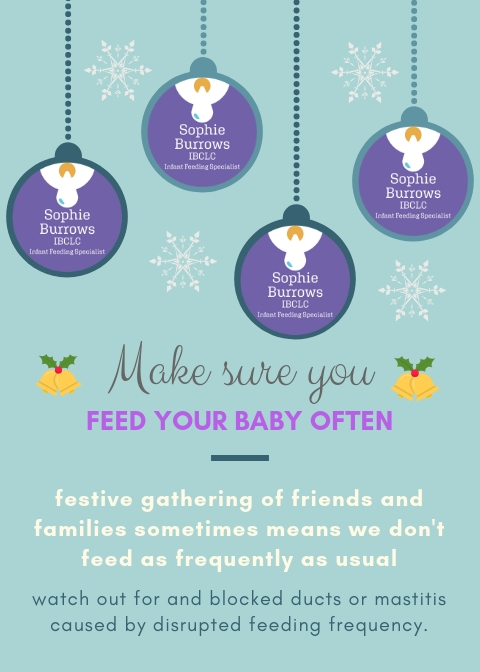
Be aware at this time of year or any time where you meet upwith lots of people who perhaps might make you feed less that feeding less can equal blocked ducts or mastitis.  Keep an eye on things and make sure you offer feeds too as a distracted baby might also need the reminder to feed too!

Most of all remember you are wonderful and if you celebrate it, Merry Christmas.

via GIPHY

Me!

Well, yes but there are many people with the IBCLC credential that work in different environments so their IBCLC credential will take on a different and important role. 

 I am an IBCLC in private practice.  This means I see mothers and babies on a request basis of the mother usually.  I go to the mother where she is and help her andher baby get through whatever feeding issues they are experiencing.

My IBCLC training means I can look for and diagnose oral issues such as tongue tie and notice palate issues.  I will go through an in-depth history with mother and baby to work out complicated and complex issues. I will offer evidence-based information and at times refer on to others for more support myself (because I’m a human and not perfect) or refer on the mother and baby to get the correct treatment to help with whatever issues might bepresent.

I have the ability to weigh your baby and can also, if needed, carry out a weighted feed to assess milk transfer in instances thatnecessitate it.  My experience with over 500 families and my love of beingin Facebook groups with breastfeeding themes means I have had the chance tolearn many varying breastfeeding situations and the best way forward with most instancesof feeding difficulty. 

As an IBCLC I support families to reach their goals, that includes everyone, LBGTQA and anywhere in between.  Want to breastfeedingyour adopted child?  yes, I’ve learnt how to support that. Want to chestfeed your baby? yes, I will support you. 

As an IBCLC I have had to go through many hours of training in various areas.  Lactation consultants follow theWHO code.


This website uses cookies. By continuing to use this site, you accept our use of cookies.  Learn more